Demos look great and open-source repos run—but the real question for most enterprises is different:
Has AI grown into your business? Are the missing core team seats written down, or are you only stacking impressive résumés?
The bottleneck is rarely "hire a few more prompt / open-source specialists." It is building the right core team for growth—diagnose the gap first, then find people.
When diagnosing gaps, two lines are often twisted into one:
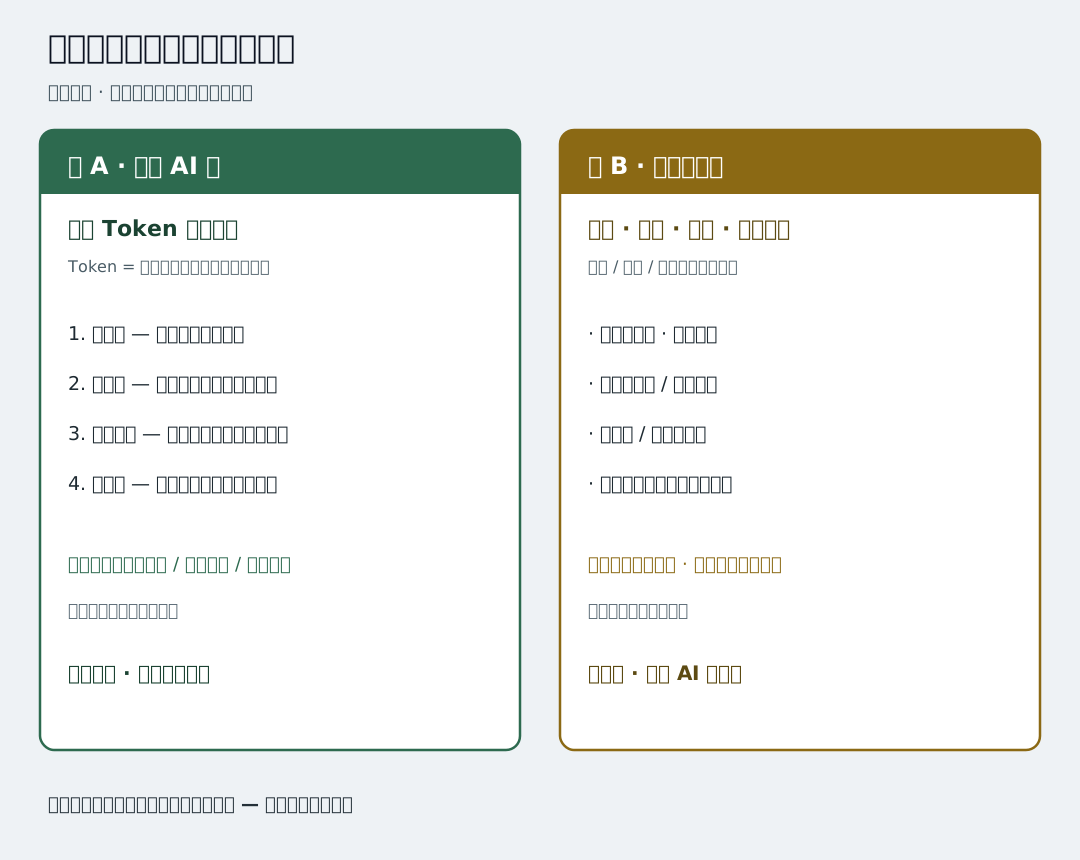
Organizational AI adoption usually starts with using Tokens (metered LLM call volume)—stable business use of models, cost/effect tracking, and owners for prompts and process.
Inference engines, productization, and on-device deployment lean toward R&D and production—important, but not a default first hire for every AI transformation.
So the shortage is not "one more inference star" or "thirty more résumés." First separate: do you need model usage in the business, or are you already building / researching / shipping at production depth?
- 1) Split the two lines
Organizational AI (use Tokens): get models into real workflows—model/API choice, pilots, prompts and process, cost/quality gates, permissions and logs. Talent often means business owners, product/ops who can run a scenario, and usage governance—not necessarily an infra number-one.
R&D and production AI capability: training, inference stacks, product engines, on-device mass production. Talent means high-end seats in inference/infra, productization, edge, and safety.
A common failure mode: the company is still stuck on "can we use it / is it expensive / can a scenario stand up," yet hires on an R&D-production org chart—people arrive with no acceptance criteria, advisors look busy, and Token usage in the business stays near zero.
Write the outcome you must deliver before you write job titles. If the outcome is "one business chain stably consumes Tokens and improves a metric," the hiring list should not default to "inference / edge / LLM engineer."
- 2) Using Tokens: the first scorecard for AI adoption
Treat "Tokens in use" as an entry acceptance check (illustrative, not a scorecard):
- 1. A scenario: support, knowledge search, drafting, coding assist, analytics—at least one main chain live.
- 2. Metering: where spend goes; unit cost vs business metrics.
- 3. Owners: who picks scenarios, who edits prompts/process, who kills dead usage.
- 4. Gates: sensitive data, external messaging, hallucination sampling—someone owns the rules.
At this stage you more often lack people who connect business and models—and clear usage governance—not a full cross-border R&D bench on day one.
Once Tokens are in use and cost/effect become operating questions, ask the next layer: self-hosted inference, product engines, on-device—add-ons, not starter requirements.
- 3) Inference · product · edge: R&D/production, enable as needed
When you truly build model products, token-priced dialogue/generation services (Token/Talk factories), on-device devices, or ship research as sellable capability, map seats by capability type (no identifiable individuals):
- Theory / paradigms → long-horizon direction
- Chips / architecture → compute programs
- Frameworks and training · inference infra → engineering and runtime
- LLM systems / edge → product-grade systems and devices
- Agents / productization → sellable capability
- Safety and governance → risk floor
These seats are expensive and scarce—valuable on the R&D/production line; treating them as standard kit for "everyone goes AI" invites wrong hires and failed acceptance.
- 4) Five traps
- 1. Hiring inference/edge the moment "AI transformation" is named → Ask: are we still not using Tokens in the business, or already building R&D/production capacity?
- 2. Proving change with "we have LLM engineers" → Ask: which business chain can show Token use and metric improvement?
- 3. Advisor theater instead of usage → Ask: who owns scenario, metering, accountability, and gates?
- 4. Résumé forwarding as matching → Ask: is the gap "use Tokens" or "R&D/production seats"?
- 5. Treating unverified name-drops as people you can book next week → Ask: authorization, willingness, and engagement form verified?
- 5) Five self-checks (line first, people second)
- 1. In the last 30 days, has at least one business chain stably used Tokens (scenario + rough volume)?
- 2. Does someone review Token cost/effect weekly and decide to scale or stop?
- 3. If "use Tokens" is not running, does the hiring list already include inference/edge/productization seats? (Usually premature.)
- 4. If you confirmed runtime / edge mass production / product engines, are seat gaps and advisor vs full-time boundaries written?
- 5. Are you driving usage, or job-level benchmarking across three-to-five R&D directions?
If Q1–2 are "no" but you are hiring hard on R&D/production: pause and get Token usage running. If Q1–2 are "yes" and the business must build delivery: do a ~30-minute talent-side gap alignment—match seats, not the slogan "AI transformation."
- 6) aipat.dev boundary
We help with diagnose → match → contracting assist for teams already (or clearly about to) build R&D/production AI capability: inference/infra, productization, edge, safety seats.
- Still on organizational AI · use Tokens: prioritize scenarios and usage governance; we can also help judge whether those seats are premature.
- Need an R&D/production bench: align seat gaps first, then anonymized capability summaries and matching.
- We do not sell "headcount in a talent pool," treat capability narratives as bookable pipelines, or substitute for full org-transformation workshops.
Unsure which line you are on? Book ~30 minutes via https://aipat.dev/
contact@aipat.dev
Closing
Cross-border AI competition is shifting from "whose résumé looks better" to "who can grow AI into the business."
Labels are plentiful; scarce are acceptable seats and activatable people. Split lines first: organizational AI starts with Tokens; inference, product, and edge are R&D/production capabilities—enable as needed.
Disclaimer: industry method observation for alignment only—not an offer to any person or institution, and not investment, legal, or employment advice. Structural judgments are not a promise of introducible names or start dates; engagement follows written scope and mutual confirmation.
aipat.dev · International elite technical talent & patent commercialization